• Home
  • Blog
    • Online reporting
  • Galleries
    • Birds
    • Other vertebrates >
      • Mammals
      • Lizards
    • Insects >
      • Moths and butterflies (Lepidoptera) >
        • Leps
      • Dragonflies and damselflies (Odonata)
      • Flies (Diptera)
      • Beetles (Coleoptera)
      • True bugs (Hemiptera)
      • Shield Bugs (Heteroptera)
      • Leaf Hoppers (Homoptera)
      • Sawflies, wasps, bees and ants (Hymenoptera)
      • Scorpionflies (Mecoptera)
      • Grasshoppers and relatives (Orthoptera)
      • Lacewings and relatives (Neuroptera)
    • Other bugs >
      • Spiders and allies
      • Snails and slugs
  • Birding
    • Travel >
      • China (Happy Island)
      • Gambia
      • Malawi
      • Lithuania and Poland
      • Morocco
      • Nepal
      • Norway (Arctic)
      • Spain (Extremadura)
      • Thailand
      • Tibet
    • Garden birds
    • Microbigyear >
      • Species list
      • Background
      • Pictures
      • Flickr
  • Contact
Nature photography by Frode Falkenberg

Next up: Arctic Norway

19/3/2013

Comments

 
There are only hours left until take-off to a week in Arctic Norway. The target is Varanger in Finnmark county. Finnmark is the northernmost mainland in Europe, and is probably the hottest destination in Norway for foreign birders. Placed at a latitude of up to 71 degrees north and a longitude similar to Istanbul, the fauna is both both unique and hard-faced.
On 16 March seabirds were counted from a height near Vardø. More than 400 000 alcids, 7 500 King Eiders and 12 000 Common Eiders were counted from a single point. Stunning numbers, and I really look forward enjoying them live!

The Hornøya bird cliff

The alcids have just returned for their breeding season at Hornøya ("Horn island") just outside Vardø. Hornøya holds thousands of pairs of Atlantic Puffins, Common and Brunnich's Murre (Guillemot), Razorbill, Kittiwakes and Shags. In addition thousands of gulls will be around at any time. The gulls will mainly be Herring, Glaucous and Great Black-backed, but we will also meet Iceland Gulls and Black-legged Kittiwakes. There is also a faint chance of seeing oddities like Ross's Gull and maybe Glaucous-winged Gull? The latter was seen a few years ago, the only Norwegian record up to date, in Vardø town.


The Gullfest

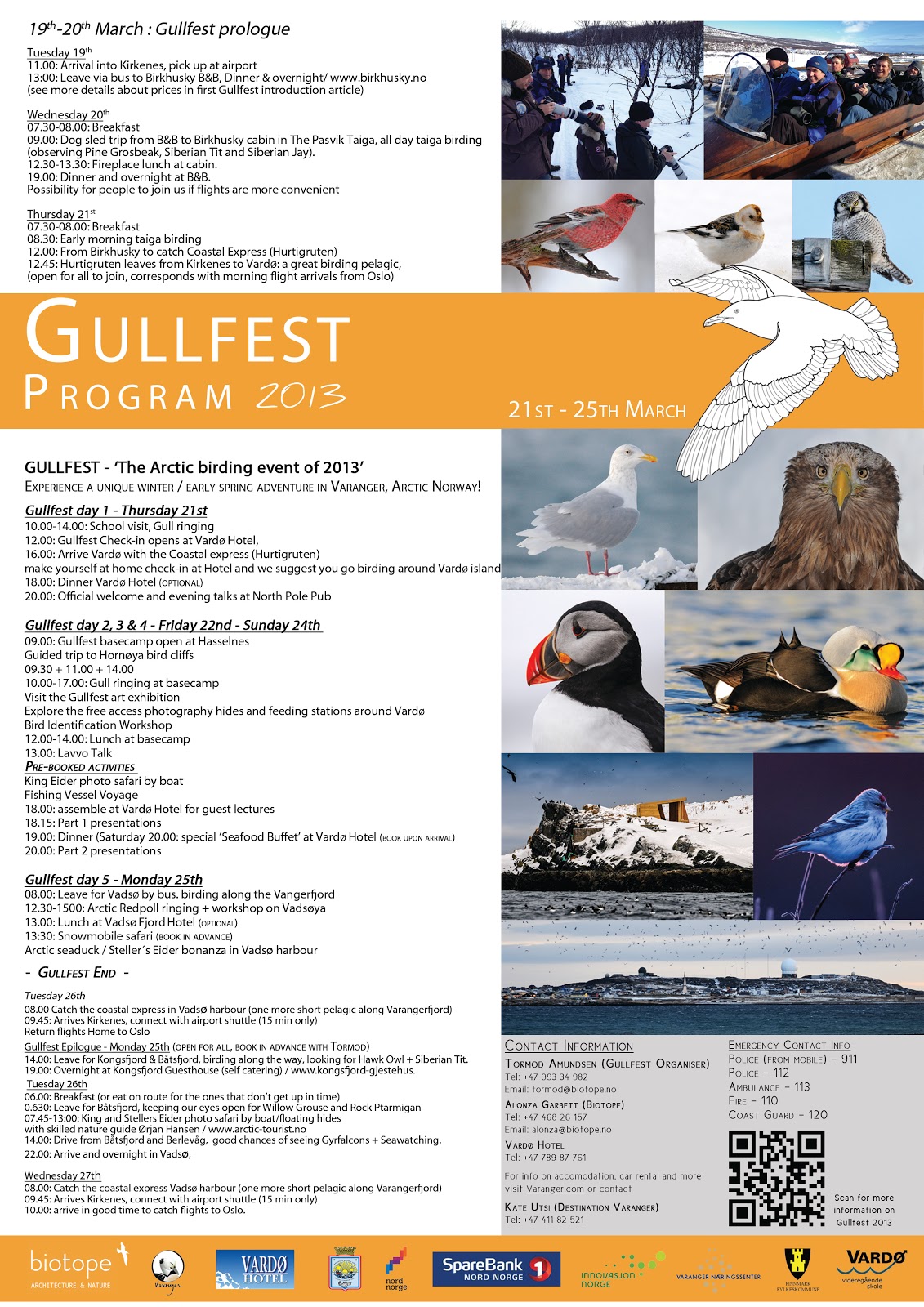
In April 2012 the first Arctic bird festival was arranged in Norway, namely the Gullfest. This year it is moved a bit forward, to 21-26 March. During the Gullfest participants will be fed with a spectacular program including ringing of Arctic gulls, visiting the Hornøya bird cliff (where tens of thousands alcids have returned), talks from several established birders and much more...
Picture

Exclusive eider-photos from floating hides

I am representing the Norwegian Ornithological Society in a project developing Finnmark as a birding destination. During my visit in Varanger I will also meet some people offering birding adventures for tourists. Exciting projects with floating hides and boat trips for photography, feeders set up to attract Arctic passerines and more.

Steller's and King Eiders, Glaucous and Iceland Gulls, Gyr Falcon, Brunnich's Guillemot, Arctic Redpolls and tens of thousands other birds - here I come! Hopefully I will serve some snapshots from the trip during the week. Stay tuned for more!
Comments

Oystercatcher breeding platform

7/3/2013

Comments

 
Picture
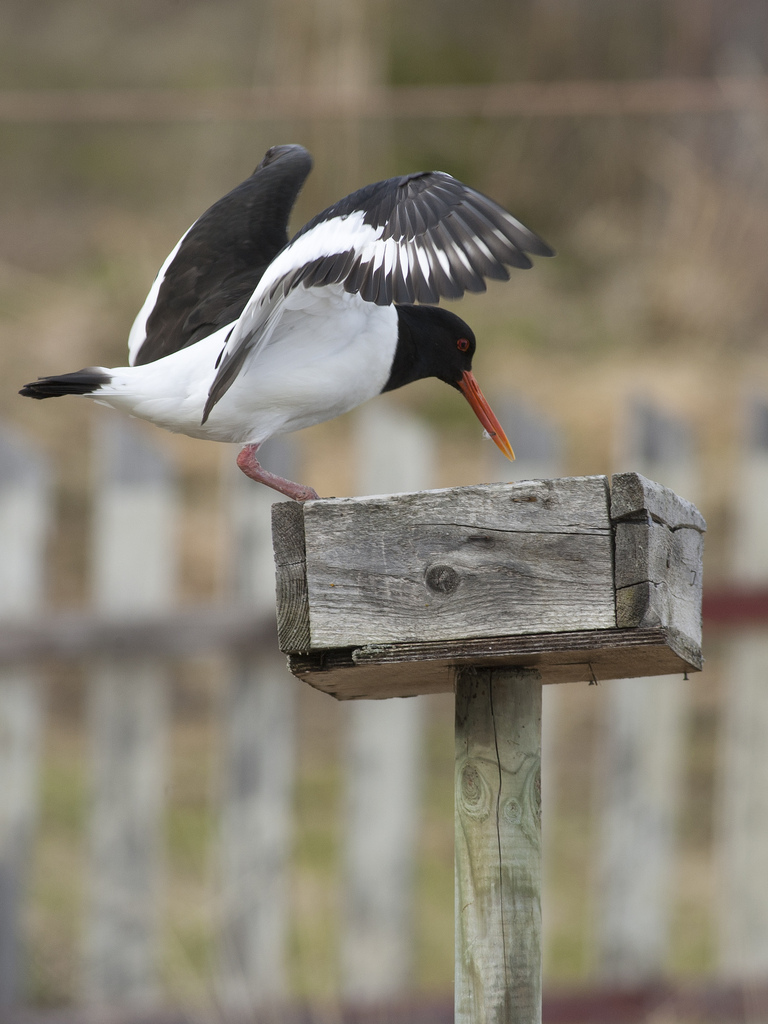
Incubating Eurasian Oystercatcher.
March is a good month for building and placing nest-boxes for passerines. Did you know that it is possible to offer Oystercatchers and Mew Gulls man-made residence as well? An easily constructed platform mounted on top of a pole may serve as a perfect nesting site for the two species. Both species breed in April and May, so it is time to build the platforms now if you want them breeding this spring.

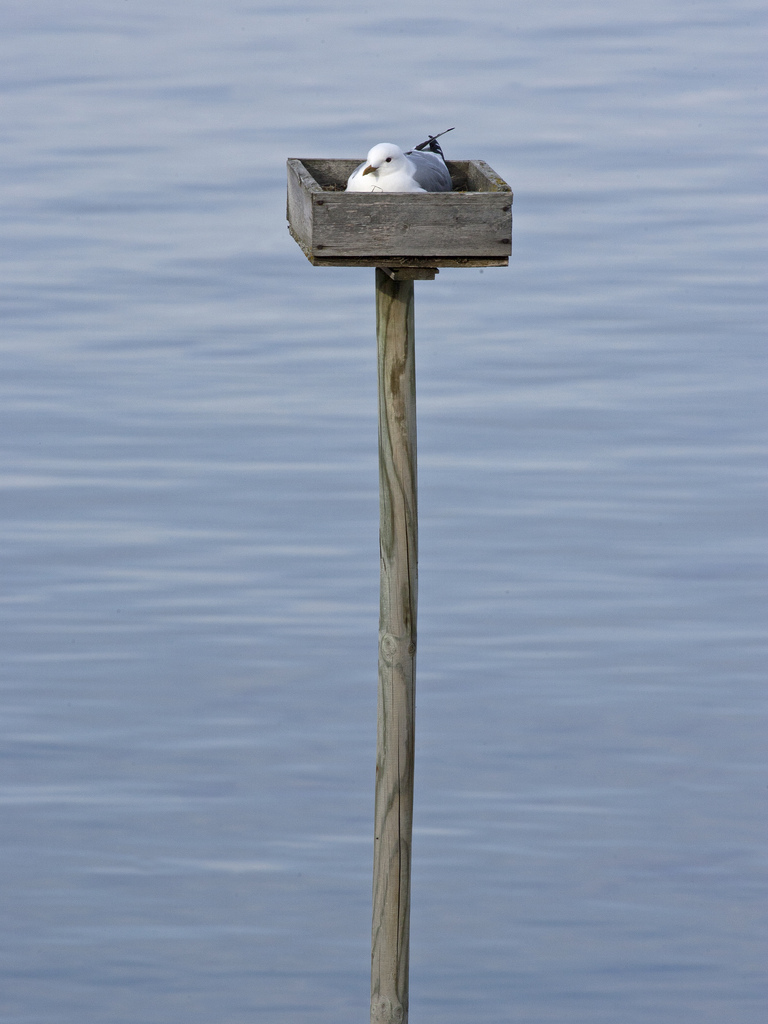
Along the shore in Porsanger, Finnmark county (map below) you can see 2-3 meter high poles with small "fenced" platforms on top. They are placed there for the birds. These pictures were taken 21 May 2011.

Both the Oystercatcher and Mew Gull usually breed on the ground. The breeding success of such species is often correlated to the local predatory pressure. Obviously, a platform such as these makes the nest unaccessible for four legged predators, such as cats and minks. In addition they will not get any problems with high tides or waves visiting their nest. At least it seems they prefer platforms before the traditional ground in this area, possibly because of increased breeding success.

Picture
After a little bit of food and a strech, it is time for further incubation.
Picture
Mew Gulls do also find the platforms suitable for breeding.
Comments

Taiga birding

4/9/2012

Comments

 
The Pasvik Valley is a tounge between Russia in the east and Finland in the west. It's longitude is about the same as Istanbul in Turkey, meaning we are as far east as we can come in Scandinavia. The habitats are a nice blend of marshes, river (that forms most of the Norwegian-Russian border), lakes and old coniferous forest. Pasvik is known for its share of eastern bird species that do not exist elsewhere in the country, and the largest population of Brown Bear in Norway lives in Pasvik.

Highlights of the day was several family groups of Siberian Jays, two Rustic Buntings, a Little Bunting, three Pine Grosbeaks, about ten Rough-legged Buzzards, twelve Cranes and lots of Siberian Tits. Some pictures from the afternoon birding and photography session 4 September 2012 follow:
Picture
The qurious Siberian Jay (Perisoreus infaustus) is an icon of the taiga forest. This bird was part of a group of five birds, and I got their attention by throwing some bread on the road. Click to view large.
Comments

Arctic Norway - taiga and tundra

6/6/2005

Comments

 
The last days of May and the first week of June 2005 (28 May - 6 June) was spent in northernmost Norway this spring. The main aim was to do some pre-breeding studies of the Red-Throated Pipit at the tundra on the Varangerhalvøya near Vadsø in Finnmark county. However, we (Professor Göran Högsted and myself) were able to fit in a few days at the start in the Pasvik valley taiga forest.

The Pasvik valley is placed at the crosspoint of Norway, Russia and Finland. The valley is an unique habitat in Norway, with regular breeding birds such as Great Grey Owl, Broad-billed Sandpiper, Spotted Redshank, Little Gull, Arctic Warbler and Little Bunting. All these species are rarities in all other Norwegian counties. We were to early for most of them, but did at least witness the fligh-courtship of Spotted Redshanks, as well as seeing great numbers of birds that usually are not annual on my species lists. On the last day, we ran across a subadult Lesser White-fronted Goose that was resting on some ploved fields. A really great and unexpeced experience with the most threatened bird in Norway.

Our drive out to the Varanger peninsula was done in two days, with lots of birding from the car. Huge numbers of Red-necked Phalaropes along the shores and in small ponds inside the shores was the most stunning appearance birdwise. There were lots of birds around, both on land and at sea, and it was strange to experience that the spring was in such an early phase compared to southern Norway.

Then followed six days at Svartnes near Vardö at the Varanger peninsula. The pipit-studies were carried out with extreme accuracy of course, and several adults were color-ringed. Göran will give these individuals further attention later this summer.

Lots of pictures from Finnmark and Arctic Norway can be found in my galleries. Here are some selected photos from the trip (click for large version):
Comments
Forward>>

    Storymaps

    Picture
    August 2024: Tracking Norwegian Black-tailed Godwits (NO) 
    Picture
    July 2023: Black-tailed Godwit fieldwork in Northern Norway (NO) 
    Picture
    June 2023: Great Snipe fieldwork at Hardangervidda, Southern Norway (NO)
    Picture
    November 2018: ​Fieldwork in three IBA's in Nepal (EN)

    Blog archive

    February 2025
    May 2024
    October 2023
    May 2023
    November 2022
    February 2022
    June 2017
    May 2017
    February 2017
    December 2016
    September 2016
    May 2016
    February 2016
    January 2016
    October 2015
    September 2015
    May 2015
    March 2015
    February 2015
    January 2015
    December 2014
    September 2014
    August 2014
    July 2014
    June 2014
    May 2014
    March 2014
    February 2014
    December 2013
    November 2013
    October 2013
    September 2013
    August 2013
    May 2013
    April 2013
    March 2013
    February 2013
    January 2013
    December 2012
    November 2012
    October 2012
    September 2012
    August 2012
    July 2012
    June 2012
    May 2012
    April 2012
    March 2012
    January 2012
    December 2011
    October 2011
    September 2011
    May 2011
    April 2011
    March 2011
    March 2010
    October 2009
    February 2008
    April 2007
    October 2006
    September 2006
    June 2006
    October 2005
    June 2005
    April 2005
    October 2004
    September 2004
    May 2004
    March 2004
    November 2003
    October 2003
    September 2003
    April 2003
    March 2003
    November 2002
    July 2002
    June 2002
    May 2002
    April 2002
    December 2001
    November 2001
    October 2001
    September 2001
    November 1999

    RSS Feed

Bird Galleries

Non passerines
​Passerines

Animal galleries

Mammals
Lizards

Spineless galleries

Moths and butterflies
​
Damselflies and dragonflies
Spiders and allies
​Snails and slugs
Flies
Beetles

Social

contact

All content on this site © Frode Falkenberg. ​Go to the contact form for comments or if you want to use material from the site.